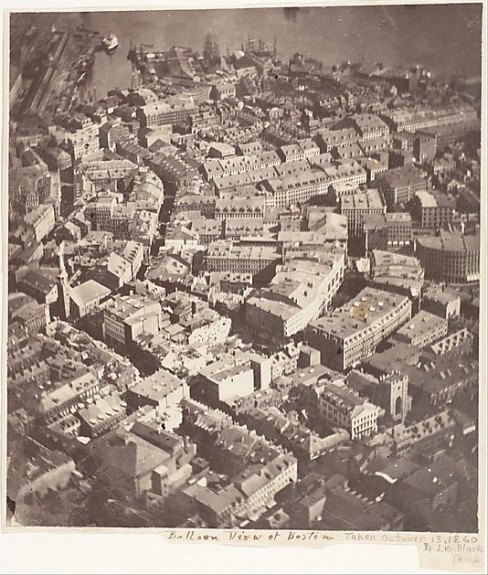
Boston seen from a balloon
An 1860 view of Boston occupies a distinctive place in photographic history. The Boston City Properties account identifies James Wallace Black as the photographer and Samuel King as the balloonist aboard the Queen of the Air, roughly 2,000 feet above the city.
The image’s significance is its survival. The account distinguishes it from Gaspard-Félix Tournachon’s earlier 1858 aerial photography near Paris, for which the original photograph was not preserved.
A city recorded before later changes
The view documents Boston before the Great Fire of 1872 and before much of the city’s later rebuilding. Black’s subsequent work photographing the fire’s aftermath offers a different historical perspective on the same city.
Balloon flight and photography developed on different timelines. The article places the Boston image within the longer history of early photography and ballooning, rather than treating it as the first photograph ever made.
The image and its name
The photograph is associated with the title “Boston, as the Eagle and the Wild Goose See It” in the Metropolitan Museum of Art’s historical presentation. The account connects that phrase with Oliver Wendell Holmes’s July 1863 Atlantic discussion.
When comparing this view with a present-day address, distinguish identifiable streets and landmarks from later structures and altered shorelines. The historical image is a record of an earlier city, not a current property view.
Historical account: Original Boston City Properties report