



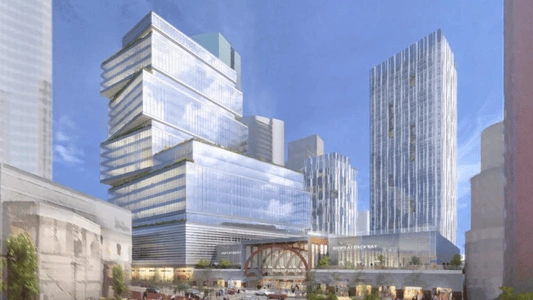
The reported pause in a 27-story office project
The Boston City Properties article dated December 11, 2024 described BXP’s decision not to anticipate breaking ground on the Back Bay office tower under the financial conditions then discussed. It placed the proposal within the Back Bay/South End Gateway Project, approved in 2017 and subsequently revised.
The report identified a proposed 27-floor tower with 660,000 square feet of office space near Columbus Avenue, Berkeley Street and Stuart Street. It also described a 90-year MBTA land lease. Those project details record the source’s earlier account; they are not a present construction status, lease offer or confirmation of a completion date.
Construction costs and financing assumptions
The source attributed the delay to the relationship between construction costs, borrowing costs and the rents a completed project might achieve. It discussed comments by BXP president Douglas Linde and comparisons with existing Back Bay office properties.
Projected debt costs, building costs and market rents change with their dates and measurement methods. The article’s figures should not be used as today’s underwriting assumptions. Its rental comparisons also left unclear whether every amount used the same period and unit, so this account does not turn them into a price comparison.
Other constraints discussed in the article
The report’s wider construction discussion covered skilled labor, permitting, community concerns, the space available to build and sustainability requirements. Each can raise different questions about a particular design, neighborhood and construction plan.
Community considerations included traffic and effects on existing neighborhoods. Site constraints concerned access and execution within a dense urban setting. Design and environmental questions require project-specific professional evaluation; a general market article cannot establish permitting outcomes or structural safety.
Possible responses were proposals, not outcomes
The article discussed revising the design, waiting for different financing or construction conditions and considering how tenant demand might develop. Those possibilities were ways of interpreting the reported delay, not commitments that any one course would be followed.
For an office-space decision, compare the actual address, required area, layout, access, timing and proposed lease or purchase. Do not assume that a delayed development makes another property available, establishes a shortage at every price level or guarantees future rents.
Original report: Boston City Properties